The Background
Why This Initiative?
5 core ideas that should be considered together
Background
This educational initiative came about because, for technological reasons, our humanity has been subject to strong change for about 20 years. Historically speaking, this is happening at an unparalleled pace and, because of its massive effects, requires societal discourse. Alongside a rise in loneliness and mental illness, the same period has seen a decline in social competencies, whose expression in democracies is also politically relevant. Decisive factors influencing this change are:
- 1The transformation of our understanding of freedom and our structure of needs
- 2The growing addictive potential of virtual worlds through a form of capitalism referred to as „limbic capitalism“
- 3AI development and the resulting acceleration of technological innovations that are revolutionizing our way of life
Limbic Capitalism
A novel form of capitalism that aims to exploit our own psychological weaknesses and the brain's reward mechanisms in order to strengthen customer loyalty and consumption.
The consequences for our society are severe, and the risk is high that we lack the experience-based adaptation time to learn quickly enough to handle those innovations in a targeted, moderate and sustainable way.
There is also the danger of an unprecedented escape from reality through ever more tempting virtual worlds. This is fostered by an „economy of loneliness“ that supplies substitute gratifications for missing social relationships. Parents often turn to their children only inadequately, who instead grow up ever more often with AI chatbots or robots.
Economy of Loneliness
A growing market of AI chatbots, virtual companions and entertainment platforms that replaces genuine social relationships with substitute gratifications - Great Britain and Japan, as the first countries in the world - in order to counteract this - have already established their own ministries for loneliness.
Ever faster technological advances bring additional potential for transformation in an extremely short time, while the promises of salvation from „transhumanists“ suggest that human beings could be technologically optimized into happier beings. This brings additional potential for transformation, in historical terms, within an extremely short time - for which we are not prepared.
It is important to expose the flashpoints of this process. This educational initiative serves to foster a societal discourse as a corrective to a technological progress whose pace would otherwise overwhelm us.
The Problem of the Learning Gap
The speed of development of technological innovations, whose addictive potential can change our social habits, is far higher than the speed of the learning processes required to use them in our long-term, well-understood self-interest.
The transmission of knowledge about the creation and technical application of innovative technologies with high addictive potential also follows entirely different rules than learning a sustainably moderate consumption of the same.
Short-Term vs. Long-Term Rationality
Learning a moderate consumption of addictive-potential technologies is not based on logical understanding alone, but requires acquiring self-knowledge in dealing with one's own needs, inclinations and weaknesses, as well as a successful behavioral adaptation as a corrective.
Pace of Technological Innovation
Pace of Our Learning Processes
Understanding Neoliberalism
How can it be that today we are well on our way to destroying ourselves, with a misguided ideal of freedom increasingly threatening our health and democracy?
To this day, neoliberalism remains one of the most powerful and socially influential ideologies of the present. To this day it has shaped not only our economic but also our everyday thinking and action more strongly than is generally known - yet this is exactly what we should now all understand better, because our future depends heavily on it.
The effects of neoliberal thinking about freedom, within the context of consuming new technologies of entertainment („limbic capitalism“) and self-optimization („transhumanism“), will have thoroughly destructive consequences for:
- mental health
- social competencies
- societal stability
- the political stability of democracies
We are not adequately prepared for this, and our democracy could easily be overwhelmed by the consequences.

„The social responsibility of business is to increase its profits.“

„Personally I prefer a liberal dictator to democratic government lacking in liberalism.“
This is why his false assumptions and lesser-known, long-term effects on individuals and society, in the context of the consumption of newer technologies of entertainment and self-optimization, must be examined and understood more closely.
His most destructive, practical consequences show themselves in the fostering of:
- individual egoism
- excess and greed
- the striving for boundless growth
- the rejection of state regulation of corporations
- misunderstandings of personal freedom
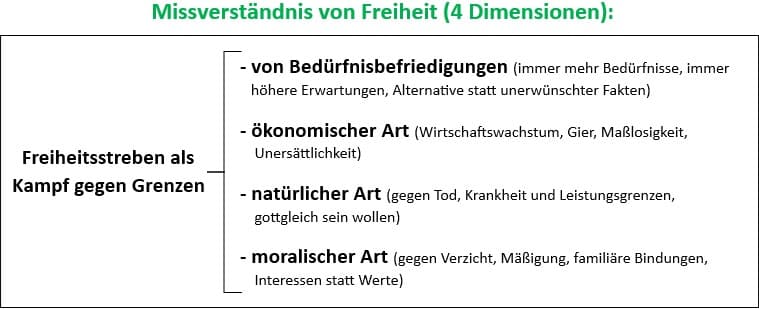
Modern Striving for Freedom as a Fight Against Limits
Our neoliberal understanding of freedom fosters the idea of boundless growth and fosters the human striving to overcome limits that are still given to us.
This favors an ethical, political and pedagogical loss of orientation, which increasingly becomes our undoing and which comes at an ever higher cost to us in terms of health and ecology.
Understanding Susceptibility to Manipulation
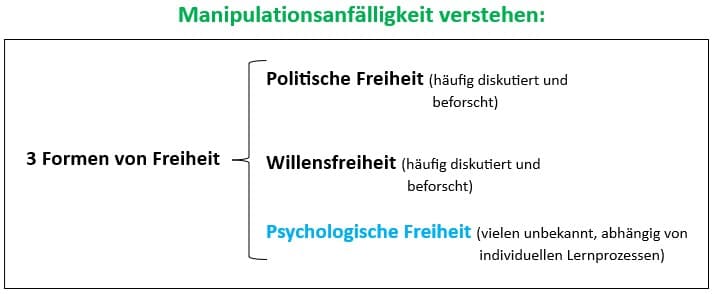
This is exactly what makes us susceptible to manipulation, since it makes it harder for us to recognize the extent to which our consumption makes us dependent and which inclinations / own weaknesses are responsible for this.
An article on the topic of self-knowledge / self-awareness